
What Are 'Set' and 'Strike'? A Pro's Guide to Event Load-in and Load-out
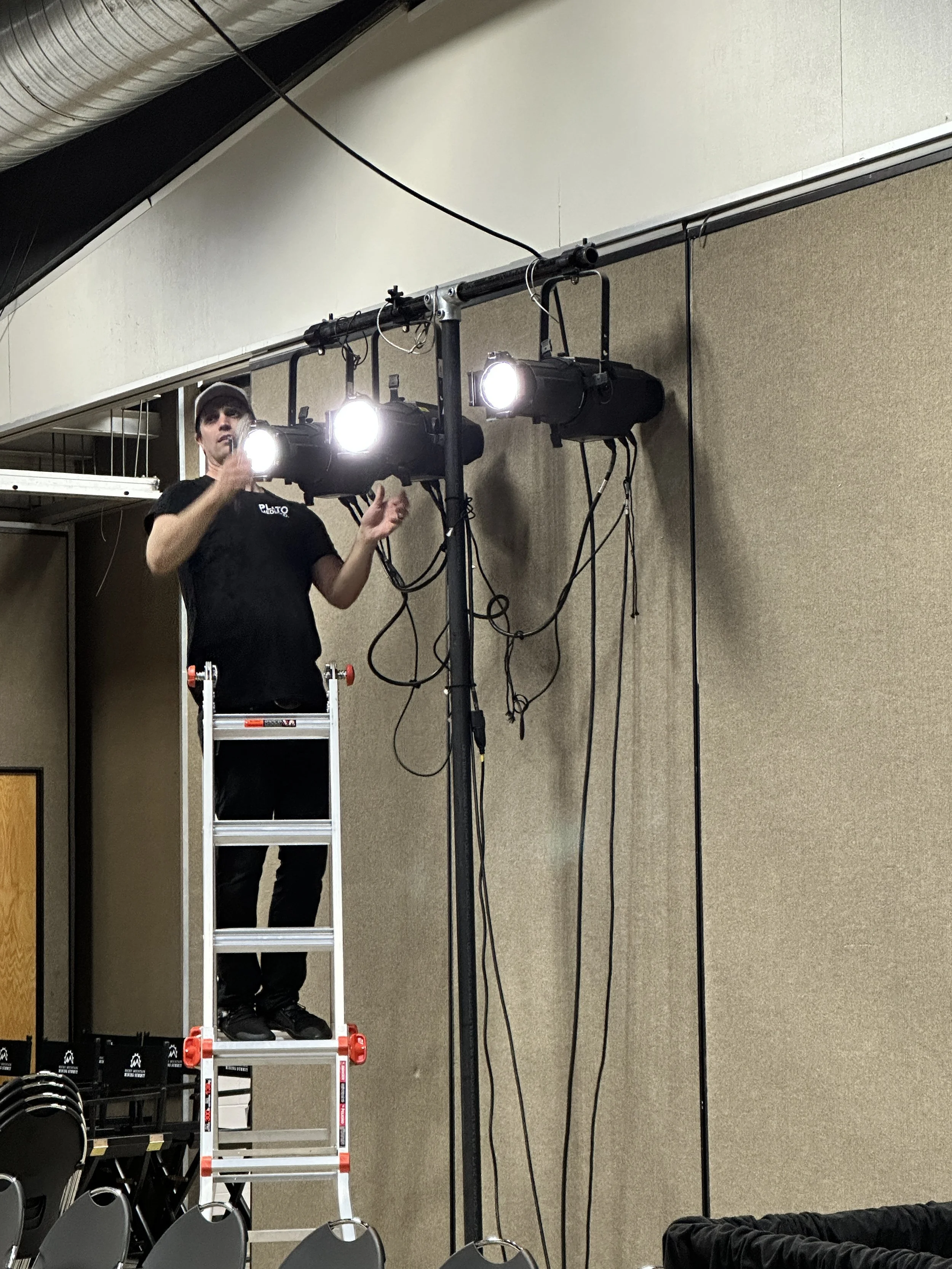
In event production, "Set" and "Strike" (also called "Load-in" and "Load-out") are two of the most critical time blocks on any schedule. These are the "bookends" of your event—the build-up and the tear-down.
Understanding what happens during these phases is key to understanding your event's timeline, labor needs, and overall budget.
1. What is "Set" (or Load-in)?
"Set" is the process of transforming an empty venue into your fully-produced event space. It's when our technical crew arrives, opens the road cases, and physically builds the show from the ground up.
This is the most time-consuming and labor-intensive part of the entire event.
During the "Set," our team is:
Unloading trucks and staging dozens (or hundreds) of equipment cases.
Building the stage and the physical "set" or backdrop.
Assembling the truss, the metal truss structures that safely hold lights and speakers, whether ground-supported or rigged.
Running all power and data cables—this is the "backbone" of the entire show.
Hanging and focusing stage lights and placing speakers for optimal sound.
Building the technical stations (the A1's audio world, the V1's video world) at the back of the room.
Placing all on-stage elements like the lectern and confidence monitors.
Taping down all cables and placing cable ramps for a clean, safe environment.
The final—and most important—step of the "Set" phase is the tech rehearsal, where we test every single one of these components to ensure they are perfect for showtime.
2. What is "Strike" (or Load-out)?
"Strike" is the "Set" process in reverse, but executed with maximum speed and efficiency. As soon as the last attendee leaves, our crew begins the tear-down.
During the "Strike," our team is:
Powering down all systems in a safe, logical order.
Coiling thousands of feet of audio, video, and lighting cables.
Carefully packing sensitive equipment, like microphones and cameras, into their designated road cases.
Lowering and dismantling the lighting and speaker trusses.
Dismantling the stage and set.
Loading the truck in a specific, organized way (often the reverse of how it was unloaded).
Doing a final sweep of the venue to ensure no equipment, tools, or tape is left behind.
Why This Matters for Your Event
Understanding Set and Strike is crucial for planners because it directly impacts your budget and your venue contract.
It Justifies Your Labor Budget: When you see "Labor" on a production quote, this is what you are paying for. It's not just for the 3 hours the event is live; it's for the 8 hours of "Set" and 4 hours of "Strike" that make the show possible. This requires a full team of skilled specialists working in harmony.
It Determines Your Venue Timeline (and Cost!): Your venue contract has a hard "out-time." If you are not completely out of the space by the time specified in your contract, you will face massive overtime fees. "Strike" is a race against that clock. A fast, efficient, professional crew saves you money by getting you out on time, every time.
Final Thoughts
Set and Strike are far more than just "setup." They are complex, physical, and technical processes that require a highly coordinated team.
A professional crew doesn't just "set up" equipment; they execute a complex technical plan safely and efficiently. When you hire Plato Media Co., you're hiring a team that has mastered this process, ensuring your event is built correctly and your Strike is completed on time.
