
Rigging vs. Ground Support: A Pro's Guide for Planners
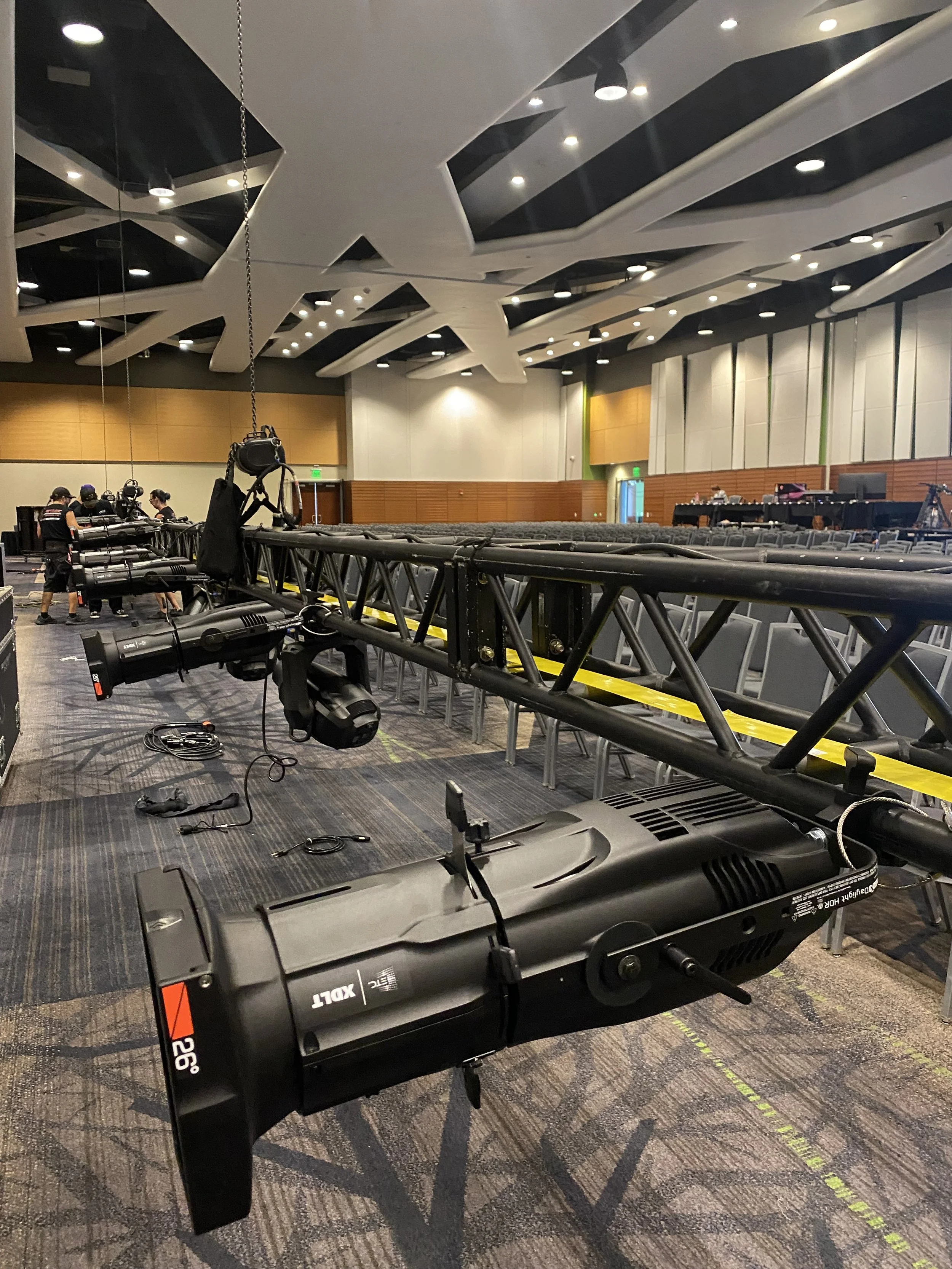
When you're in a large ballroom for a general session, you'll sometimes see speakers and stage lights hanging from the ceiling. This creates a clean, professional, "arena" feel with perfect sightlines.
But how does that gear get up there? And is it always necessary?
This is where two core production methods come in: ground support and rigging. Understanding the difference is one of the most important factors in your event's design, budget, and timeline.
1. What is Ground Support?
Ground support is exactly what it sounds like: any production equipment that is supported from the ground up.
The simplest example is a speaker on a tripod stand or lights on a vertical pole (a "light tree"). For a larger, more professional setup, we build "truss towers" or "goal posts"—these are stable, scaffold-like structures made of metal truss that can hold LED screens, speakers, and/or lights.
Pros of Ground Support:
Cost-Effective: Typically requires less labor and no special venue fees.
Fast: A ground-supported setup is much faster during Set & Strike.
Works Anywhere: It's the only solution for venues with low ceilings, historic architecture, or no structural ceiling points.
Cons of Ground Support:
Aesthetics: It can look less "clean" than a "flown" system.
Floor Space: The truss towers and support legs take up valuable floor space.
Sightlines: Depending on the room, the structures can sometimes obstruct an audience member's view.
2. What is Rigging?
Rigging is the complex (and highly-regulated) process of safely hanging equipment—like truss, lights, speakers, and screens—from a venue's ceiling beams or designated "rigging points." This is what we call "flying" the gear.
Pros of Rigging:
The "Pro" Look: It creates a clean, high-end, broadcast-quality aesthetic.
Perfect Sightlines: It gets all the hardware up and out of the way, giving every attendee a perfect view.
Immersive Design: It allows for more complex and creative lighting and audio designs that can cover an entire ballroom.
Cons of Rigging:
Cost: Rigging is significantly more expensive than ground support.
Time: It adds many hours to the "Set" day.
Venue-Dependent: It's only possible if the venue has the structural capacity and permits it.
Why is Rigging So Much More Expensive?
This is the question every client asks, and it's a good one. The high cost of rigging is not just about the production company; it's a combination of three factors: venue policies, specialized labor, and time.
1. Exclusive Venue Fees & "Riggers"
This is the biggest factor. Most large hotels and convention centers have an exclusive in-house rigging policies. This means that even though we are your production partner, the venue requires us (and you) to hire their specific team to handle any and all rigging.
These venue-appointed riggers are the only people allowed to operate the lifts and attach anything to the ceiling. This fee is a non-negotiable venue charge that is passed on to you.
2. Specialized, Certified Labor
You don't just "hang" thousands of pounds of gear over an audience's head. Rigging is a high-stakes, specialized skill that requires certified and insured engineers (often called "riggers").
These specialists must review the equipment load, perform complex engineering calculations to ensure structural safety, and physically build the motors and attach the gear. You are paying for their expertise to guarantee no one gets hurt.
3. Time and Complexity
A "ground support" setup starts when our trucks unload. A "rigged" setup adds a major step before that. The riggers must first come in, build and fly all the "motor points" and truss, and then our AV crew can begin our setup. This adds hours (and sometimes an entire day) to the "Set" timeline, which adds to the labor cost.
Final Thoughts: Which One is Right for My Event?
The choice between ground support and rigging depends on your goals, budget, and venue.
Choose Ground Support if: You are in a smaller ballroom, a breakout room, a venue with no rigging points, or if your priority is to be budget-conscious. A good production team can design a ground-supported system that still looks fantastic.
Choose Rigging if: You are in a large general session, you must have clear sightlines for a large audience, and you are aiming for that high-end, "wow-factor" production.
When we build a quote, we are your partner in this decision. We'll work with the venue to get the rigging costs for you, and we can often design a hybrid or a powerful ground-supported system that meets your goals without breaking the bank.
